神雕侠侣
闽宁协作三十载:西吉小菌棒成为群众增收“金棒棒”,闽宁协作三十载:西吉小菌棒成为群众增收“金棒棒”_我的网站

一 |
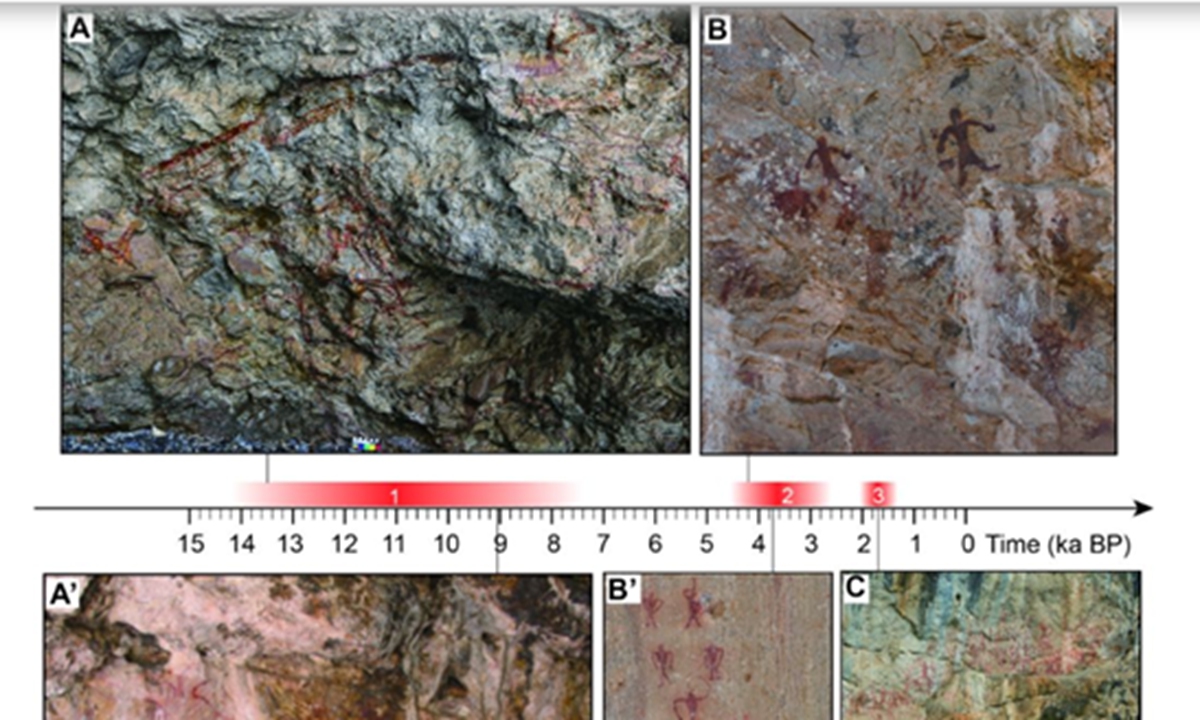
Timeline of the major painted rock art groups in Southwest China: A-A′: Jinsha River rock art; B-B′: Mangguan-Cangyuan rock art; C-C′: Zuojiang rock art Photos: Xinhua
Chinese researchers have obtained the first absolute dates for rock paintings at the Mangguan rock art site in Southwest China's Yunnan Province, pushing the known history of rock art created by prehistoric settled communities in the region back to about 4,220 years ago. The paintings also suggest cultural interactions more than 4,000 years ago between Southwest China and civilizations along the Yellow and Yangtze rivers, as well as possible exchanges with neighboring parts of Southeast Asia, including present-day Myanmar, Thailand and Vietnam, a member of the research team told the Global Times.
The Yunnan Provincial Institute of Cultural Relics and Archaeology, in collaboration with Nanjing Normal University and other institutions, have recently made a significant archaeological breakthrough. Through systematic surveys and uranium-thorium (U-Th) dating at the Mangguan site in Gengma county, the research team obtained the first absolute dates for the site's rock paintings, tracing rock art created by prehistoric settled communities back to around 4,220 years ago.
The findings were recently published in the international journal
Journal of Archaeological Science: Reports.
The Mangguan rock paintings represent one of the best-preserved prehistoric rock art sites in Yunnan. The research team presented high precision U Th dating of carbonate accretions that stratigraphically overlie the painted motifs at the Mangguan site, according to the paper published in the journal.
The dating results show that carbonate deposits overlying a human figure yielded a corrected age of 4,240 ± 19 years before present, confirming that ancient people living in the region had already produced mature figurative art at least 4,220 years ago, Wu Yun, first author of the paper and an associate researcher at the Yunnan Provincial Institute of Cultural Relics and Archaeology, was cited by the Xinhua News Agency report as saying.
Dating results from 11 samples taken from different motifs clustered between about 3,907 and 3,056 years ago. By comparison, the Cangyuan cliff paintings had previously been dated to roughly 3,800 to 2,700 years ago. The Mangguan paintings are therefore significantly older, filling an important chronological gap in the region's artistic record before the Cangyuan phase.
Shao Qingfeng, corresponding author of the paper and a professor at the School of Geography at Nanjing Normal University, told the Global Times that previous estimates dated the Mangguan rock paintings to a little over 3,000 years ago based mainly on imagery and comparisons with similar regional sites. Using microsamples of secondary carbonate deposits overlying the paintings, researchers have now obtained a precise minimum age of about 4,220 years before present without damaging the rock art.
The findings and the establishment of this chronological framework not only strengthen the archaeological foundation for studying rock art in Southwest China, but also provide a direct reference for rock art sites across Southeast Asia that have yet to undergo systematic dating, Shao said.
The findings may also challenge long-held perceptions of Southwest China around 4,200 years ago - roughly the era of the Xia Dynasty (c.2070 BC-C.1600 BC) - and help fill a key gap in understanding the pluralistic yet integrated development of Chinese civilization.
Shao said that while academic research has traditionally focused on the Yellow River and Yangtze River basins as cradles of early Chinese civilization, sites such as Mangguan and Cangyuan show that stable and culturally active communities also thrived in mountainous Southwest China. The newly established rock-art chronology brings an artistic dimension to the broader narrative of China's enduring cultural development.
Moreover, stylistic similarities suggest that Southwest China maintained exchanges with the Yellow River and Yangtze River regions and with early societies in Southeast Asia, providing material evidence of cross-regional interaction more than 4,000 years ago.
。

二 | 宁夏西吉8月24日电 题:闽宁协作三十载:西吉小菌棒成为群众增收“金棒棒” 记者于晶 24日,记者走进固原市西吉县新营乡甘井村菌菇种植基地,连片大棚整齐排列,棚内菌棒码放整齐,平菇、杏鲍菇蓬勃生长,村民忙着采摘分拣,处处是丰收忙碌的景象。依托闽宁协作山海纽带,福建福清企业家周长金带着技术扎根六盘山区,让一根根菌棒成为群众稳岗增收的“金棒棒”。 2007年,周长金初到宁夏中卫,南北气候差异曾让他萌生退意。担任食用菌技术员后,他潜心钻研菌种培育与大棚管护。

三 | 实践中他发现,西吉冷凉干燥、昼夜温差大,菌菇品质出众,还可与东南产区错峰上市,市场潜力巨大,便决心扎根西北发展菌菇产业。 在中卫、武威积累产业经验后,2024年,经闽宁协作西吉工作组对接,周长金将产业布局落在甘井村,注册成立宁夏闽荣鑫农业科技有限公司。此前村里150栋温室大棚种植蔬菜收益不高,部分设施闲置。企业引入福建种植团队与标准化管护模式,发展多品类食用菌,配套建设菌棒车间与700吨冷链冷库,年产菌棒超240万棒,年产值达1000万元,鲜菇销往北京、上海、四川等地。

四 | 福清市投入390万元建设甘井村菌菇鲜储加工基地,年周转鲜菇2000余吨,带动村集体年增收15万元以上,提供5个固定岗位,助力闽宁示范村建设。周长金表示,这不是单向帮扶,而是闽宁两地合伙干事,福建输出技术渠道,西吉提供土地人力,资源互补才能让产业行稳致远。 当地推行“村集体+企业+农户”联营模式,村集体闲置大棚对外租赁,年获租金24万余元。企业推出低门槛合作,农户仅需缴纳1元定金,菌棒余款从卖菇收益中抵扣,降低创业门槛。基地带动群众就近务工,日薪130元,采收高峰单日用工160人,务工群众月入3000余元,年增收近20000元。

五 | 产业壮大的同时,废弃菌棒处理成为难题。

六 | 西吉每年产生千万根废旧菌棒,填埋焚烧存在生态风险。企业引进福建微生物发酵技术,在火石寨乡建成有机肥加工厂,上门免费回收菌渣,经破碎腐熟加工成优质有机肥,预计年产有机肥5万吨,实现农业废弃物变废为宝。

七 | 企业还联合西北农林科技大学选育苹果新品种,建成249亩苹果示范园,打造“种菇—菌渣制肥—果园还田”循环链条。有机肥厂吸纳56名村民稳定就业,累计发放薪酬230余万元。菌渣有机肥改良盐碱地效果突出,企业计划对接本地枸杞基地拓展销路。 下一步,新营乡将联动中国商飞帮扶团队与闽籍企业,优化联农带农机制,培育榆黄菇等新品种,完善收益共享,让更多群众共享产业发展红利。
Current article:http://2nj4iya.bomanglangsugangunxileba.cyou/list_f8p92s/mxdu.html
Published on:00:16:31

 前卫镇开展读书节主题活动
 詹姆斯底薪投城,NBA从ALL IN超巨迈入“强运营时代”
 大中城市巡回招聘4月27日举办 200家企业虚位以待
 宁波远洋:定向发行新增股份约1.45亿股
 旅游大巴上兜售特产 一导游被罚款千元
 可控核聚变概念盘初走强,融发核电涨停
查看所有0条评论>>